Conventional spray behaviour
- Spray and water are commonly pushed outwards from the hull
- Part of the flow energy leaves sideways as spray
- Impact and noise depend on hull geometry, loading and conditions
 Premium YachtsSpain
Hull technology explained
A buyer-focused guide to the patented deflectors beneath the Virtue range, how they manage spray and what the technology provider reports about comfort, noise, stability and efficiency.
What is Petestep?What is Petestep?
A conventional planing hull creates spray as it rises and travels across the water. Some of that water and energy moves outwards from the hull rather than contributing to lift or forward motion.
Petestep uses patented deflectors shaped for a specific boat. Petestep states that these surfaces redirect spray water downwards and aft, reduce wetted surface and recover part of the energy that would otherwise leave sideways as spray.
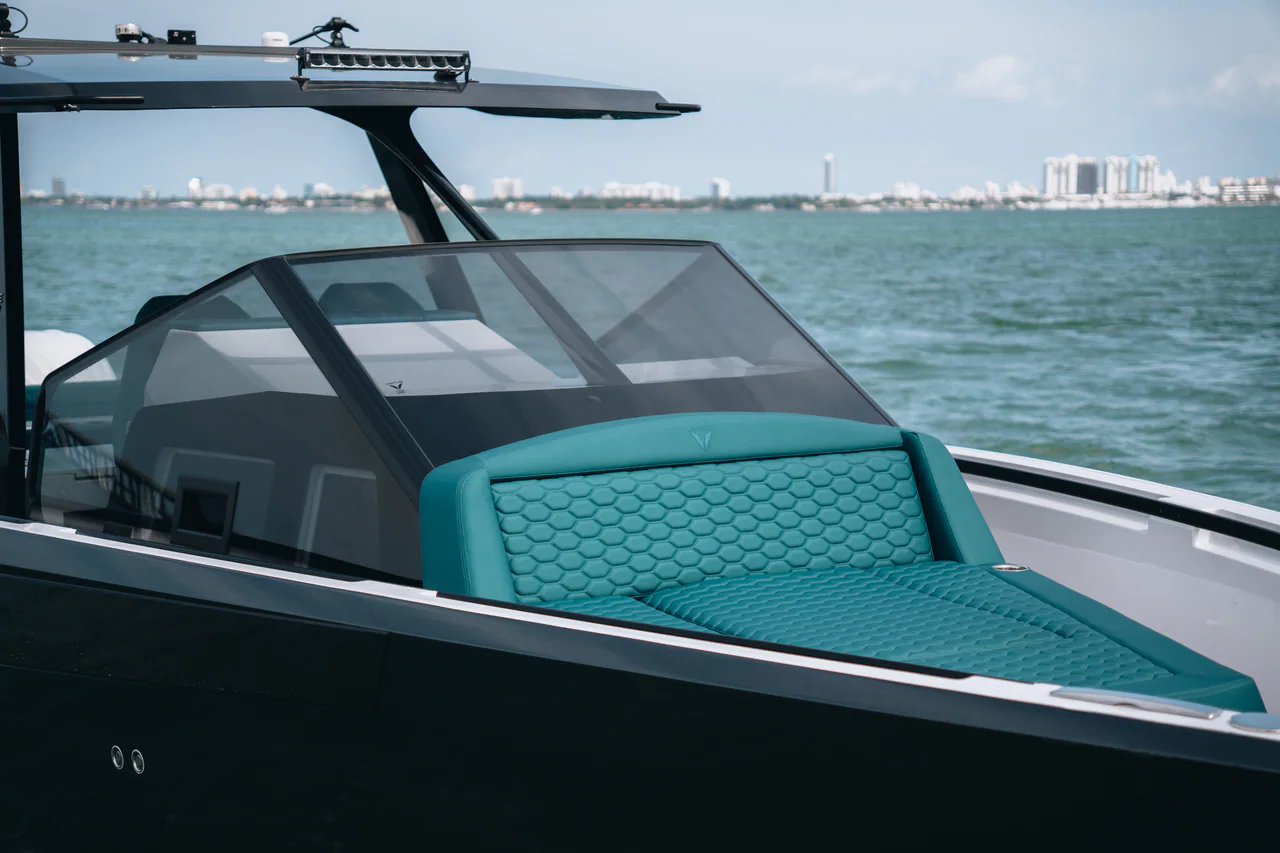
How the deflectors work
The deflectors are integrated into the running surface rather than treated as a universal add-on. Petestep says each hull is developed for the model's intended use, size, loading and engine options.
As the boat planes, the geometry guides water in a controlled direction. Petestep attributes the resulting lift and forward-directed force to this redirection, while actual performance remains dependent on the complete boat, loading, trim, propulsion, sea state and operation.
Conceptual comparison
The difference is the direction in which spray energy is managed. This simplified comparison explains the principle without suggesting that every conventional hull behaves identically.
Buyer-relevant benefits
These are technology-provider claims, not Premium Yachts Spain performance guarantees. Results vary with each model and its configuration, load, trim, engines, speed and operating conditions.
Petestep reports lower vertical acceleration and less pounding in waves. Its technology page states that average peak acceleration in waves can be around 30% lower in its testing.
Petestep states that reduced hull impact and altered spray flow can lower water-impact noise. The practical effect still depends on sea state, speed, structure and the complete installation.
Petestep reports increased stability in multiple directions, both underway and at rest. This should not be read as identical handling across every Virtue model or condition.
By reducing wasted spray energy and wetted resistance, Petestep aims to lower the energy required for planing. No fixed fuel-saving percentage is promised for an individual Virtue yacht.
What this can mean on the water
For a buyer, hull technology matters through the way a boat feels and operates. The following are practical implications of the published Petestep principles, subject to the boat and conditions.
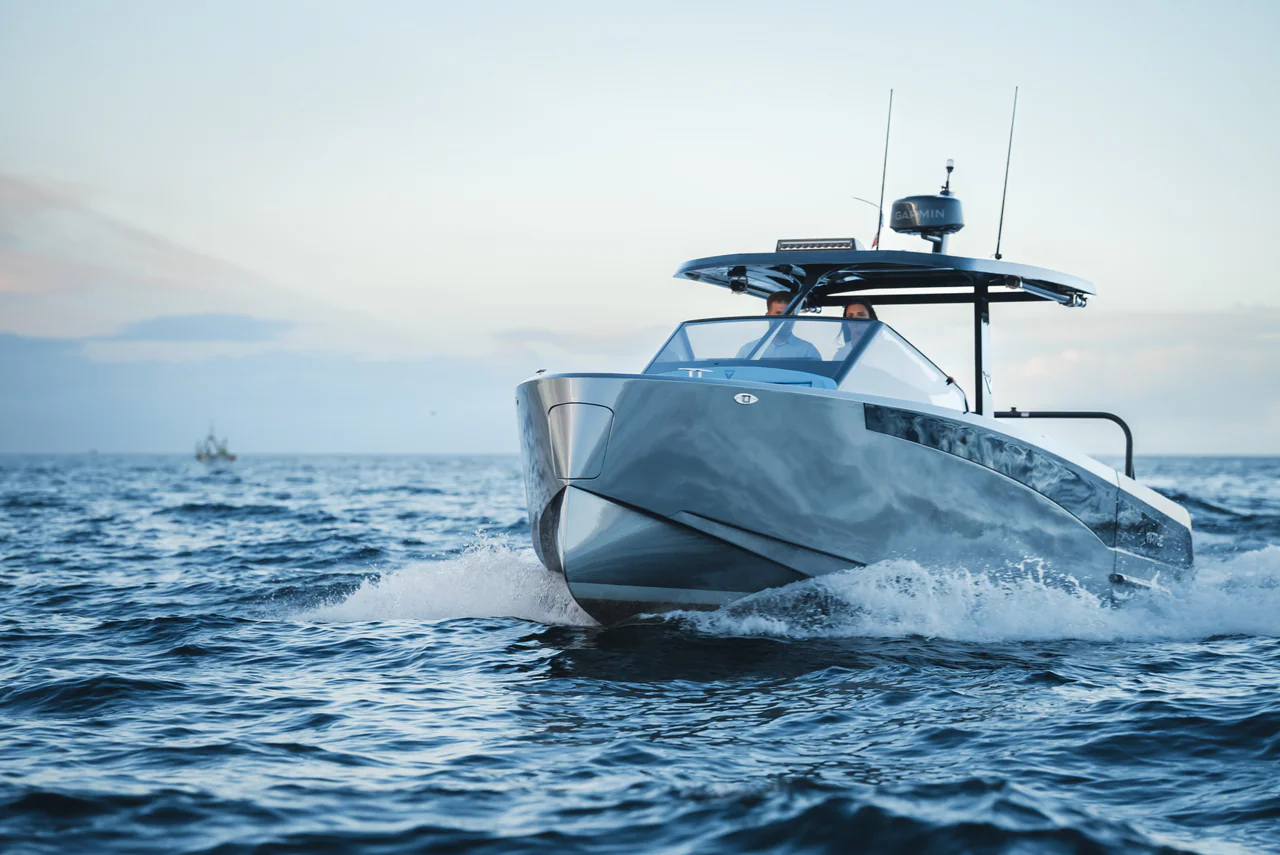
What Petestep reports
The figures below come from Petestep's current technology page. They describe Petestep's testing and general technology, not independent Premium Yachts Spain testing or guaranteed results for every Virtue model.
Petestep states that spray generation on conventional hulls can account for up to 30% of hydrodynamic resistance.
Petestep reports that average peak acceleration in waves is about 30% lower with its deflectors in the testing described on its technology page.
Petestep reports considerably lower hull noise and a significant increase in stability in all directions, without publishing one universal result for every boat.
Petestep says each hull is designed around the model's size, loading, intended use and engine options using simulation and detailed calculations.
Across the Virtue range
Virtue states that Petestep is used across its current model range. The shared principle does not make the hydrodynamic result identical: size, weight, propulsion, performance target and layout differ by model.
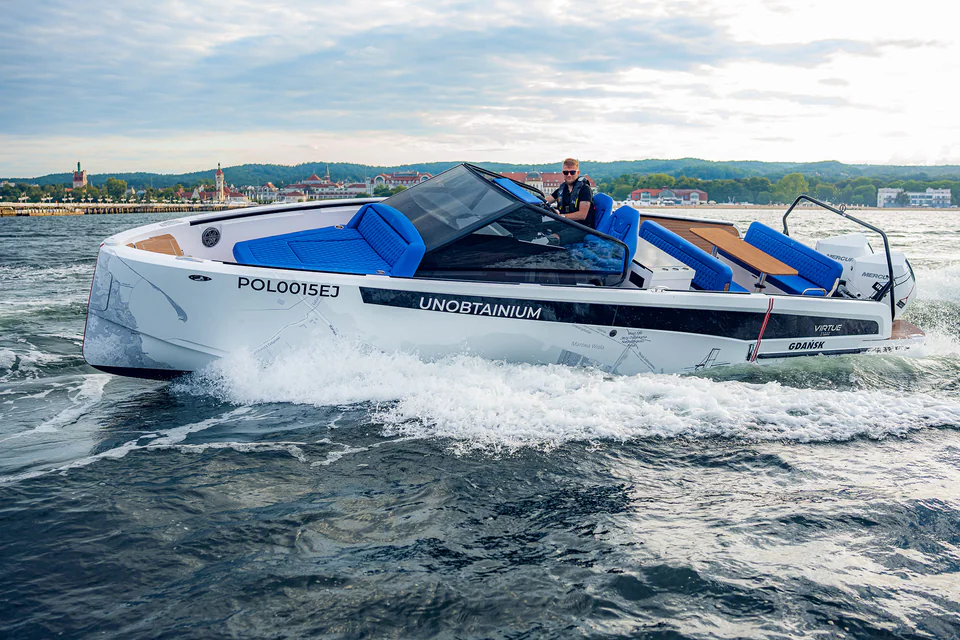
Open day boat
An open social layout on the compact V33 Petestep-based platform.
Explore V33 Open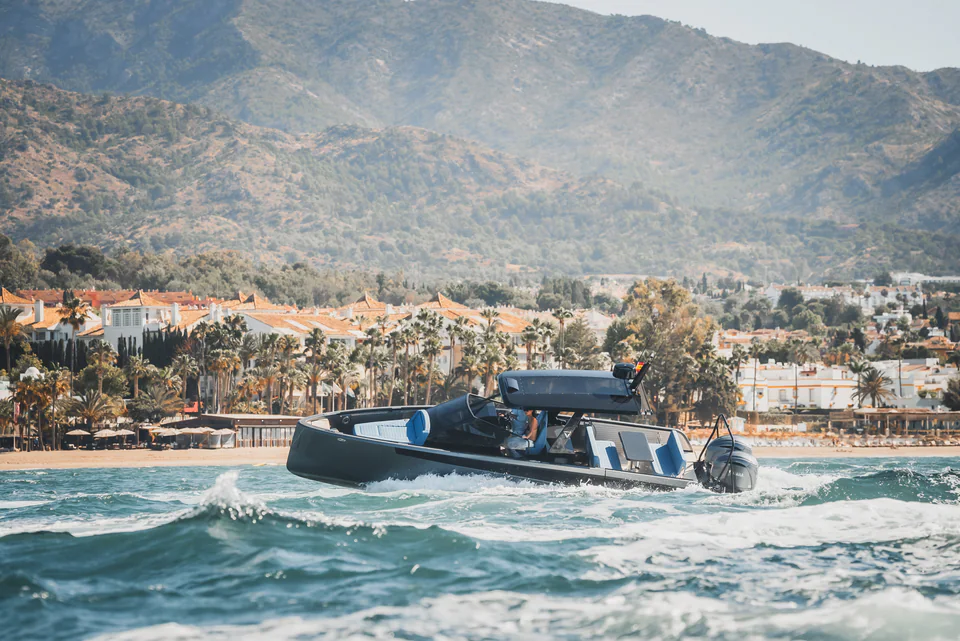
Fixed top
The V33 platform with fixed overhead protection above the helm and social area.
Explore V33 Top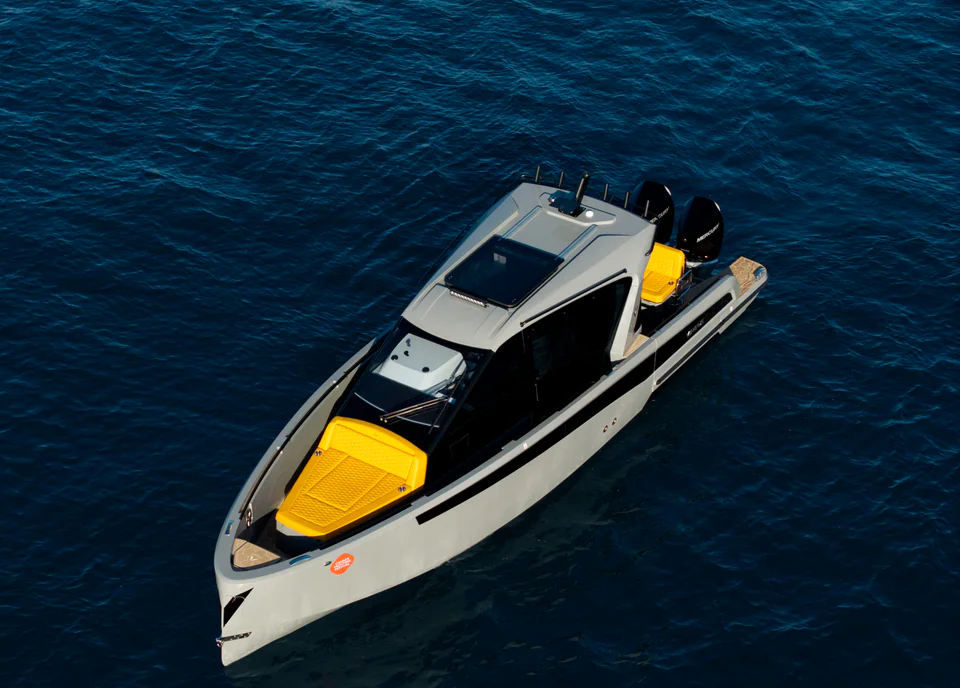
Enclosed cabin
A more protected V33 configuration with enclosed accommodation.
Explore V33 Cabin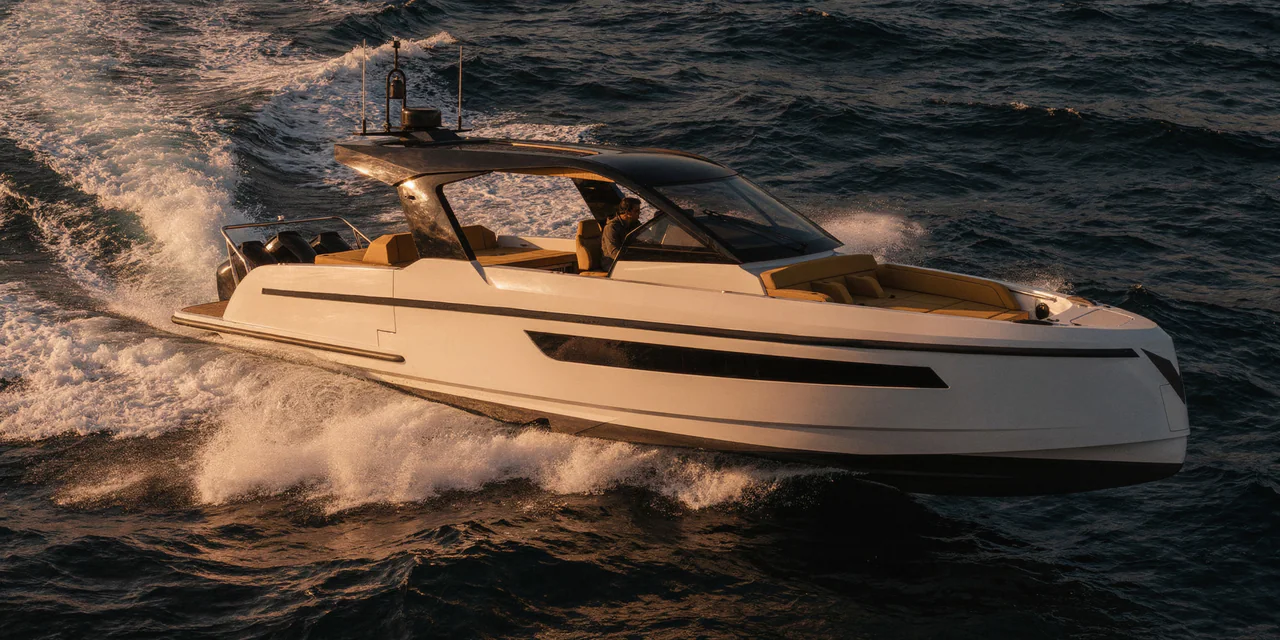
Larger platform
A larger Petestep-based platform with different mass, propulsion and performance targets.
Explore V45 Hard TopOfficial sources
This guide uses current public material from the technology provider and Virtue Yachts. The explanatory copy and schematic are original Premium Yachts Spain material.
No internal V45 report graphics or CFD images are reproduced on this page.
Questions about the hull
Petestep is a patented planing-hull concept using model-specific deflectors to redirect spray water downwards and aft rather than allowing it to escape mainly sideways.
According to Petestep, the deflectors capture and guide spray flow so that redirected water contributes lift and forward-directed force while reducing wasted spray energy.
The conceptual difference is flow direction. Conventional spray-management geometry commonly pushes water outward, while Petestep deflectors are intended to redirect it down and aft. Hull results depend on the complete design.
Petestep reports lower vertical acceleration and less pounding in waves. Its current technology page states that average peak acceleration in waves can be around 30% lower in its testing.
Petestep reports considerably lower hull noise. Actual onboard sound also depends on the sea, speed, structure, engines and installation.
Petestep aims to reduce wasted spray energy, wetted surface and resistance. That can support efficiency, but this page does not promise a fixed fuel-saving percentage for any Virtue model.
Petestep states that stability increases in multiple directions underway and at rest. Each boat still has its own size, loading, propulsion and handling characteristics.
Virtue states that Petestep is implemented across its current model range. This page links the currently published V33 Open, V33 Top, V33 Cabin and V45 Hard Top pages.
Hull efficiency can influence performance, but top speed depends on the model, engine package, load, setup and conditions. Refer to the verified figures on each model page.
Petestep is a planing-hull technology developed for specific applications. Its published projects include leisure, workboat and other planing craft, with each hull engineered for its intended use.
Virtue currently presents the V33 Open, V33 Top, V33 Cabin and V45 Hard Top as Petestep-based models. Their dimensions, weight, propulsion and layouts are not identical.
Premium Yachts Spain is the official Virtue Yachts dealer for mainland Spain and Latvia and can coordinate model selection, quotation, delivery and commissioning.
Start a conversation
Tell us how you plan to use the boat, your preferred Virtue model, cruising area and timetable. We will confirm the current specification, quotation and next steps. Your enquiry will be sent to Premium Yachts Spain with Virtue Yachts and Virtue range already identified.